I.
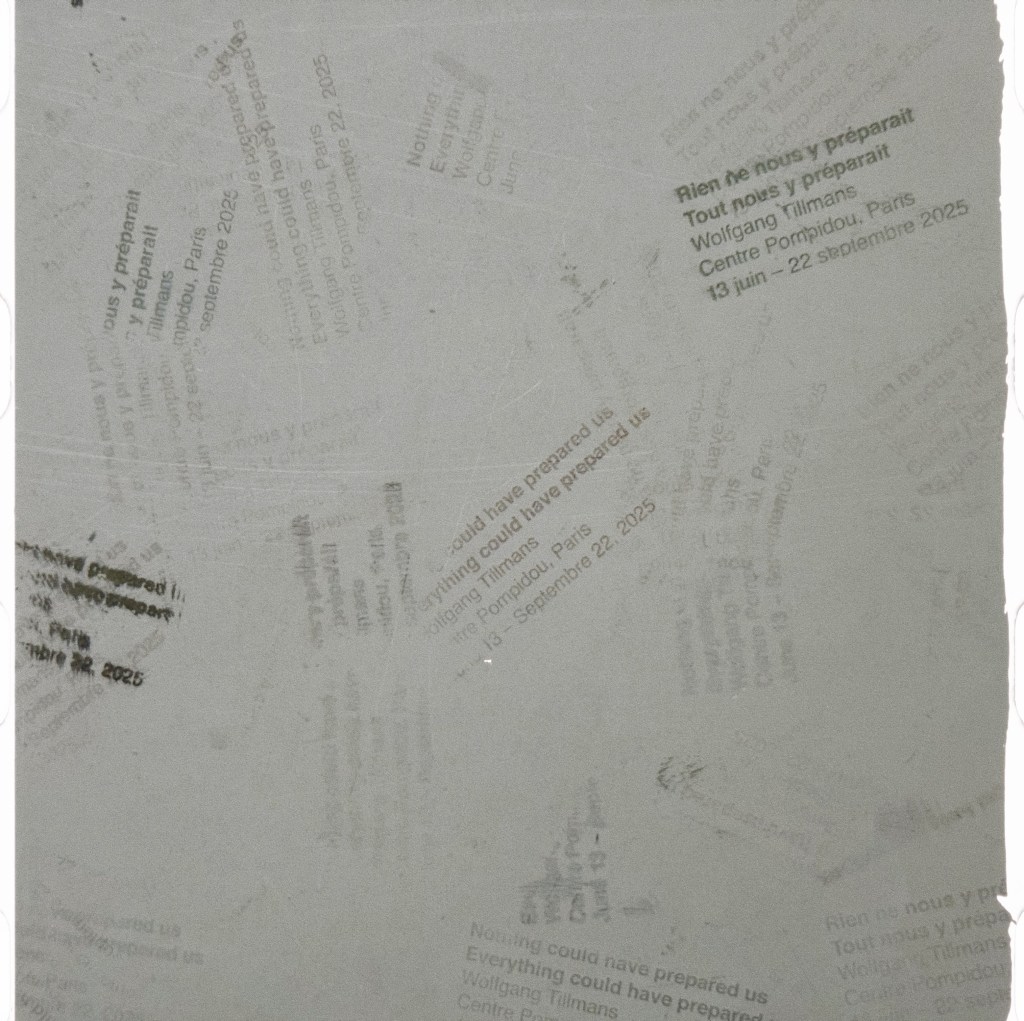
Wolfgang Tillmans’ show at Centre Pompidou in Paris is summed up in his own words. The preface of one of his books lies open in French and English under one of the Truth Study Center (2005-) tables, and I read it in both. I didn’t want my published coverage to be a regurgitation. I’m scared it is, and is going to continue to be, but there’s more on the matter at hand. The work says what it says but you weren’t there to see it. So I’ll tell you.
As I said, I was confronted.
One table is dedicated to American news outlets reporting on government censorship of public records as of this year. Another displays a bloody baby about to be cut by its umbilical cord next to a pair of feet caressing each other in cotton, next to two elderly women interlocked on the sidewalk on top of a man sleeping on a couch and another with his arms balanced on the walls of a shower—until the image of Jesus hanging on the cross. Text criticizes President George W. Bush, “who turned his drinking problem into another kind of addiction called religion.”
Images project from a hamster wheel lined with film and its running like a cartoon. I’ve got to have fun with a metaphor because a reality absurd enough to be one isn’t so much.
Above Le Monde is a Comment & Debate in The Guardian by Pankaj Mishra from 2009 folded in half: “Behind the violence in Gujarat, Gaza and Iraq is the banality of democracy.” He reminds us of Modi’s supervised killing of more than two thousand Muslims in 2002, just to watch the citizens continue to vote for him enough for a landslide, even after Hindu nationalists boasted on tape about raping and dismembering other members of the human race. He asks, “can the instructions of electoral democracy, liberal capitalism, and the nation-state be relied upon to do our moral thinking for us?”
The work translates well into language—das an sich-style—because an image is a word and there are many of both. Not like Tillmans didn’t say that already.
“For reflected light from my skin to be refracted into an image of myself upside down projected onto a sensor/film at the back of your camera,” he says to the left of two images in a “Memorial for the Victims of Organized Religion.”
II.
I thought about how the curation at Hudinilson Júnior’s show at 15 Orient should have seen Tillmans’ first. And I thought about that critique in Hyperallergic of Diane’s recent exhibition at Park Avenue Armory and how daft it was, hitting a target but missing the mark. The author’s condemnation of it being akin to doomscrolling bothered me. He’s mad at the polarization of subject and lack of direction as if life isn’t exactly that.
You want to cling to humanity and kindness? Go to the Color Factory. Buy some new glasses. Because a picture of a picture is never as good as the first copy anyway. You want to show me what you saw? Tell me!
I came to Paris so I could breathe. How refreshing it was to see images that said something, instead of all these images pretending to say something. Because God, New York loves a Name.
I want to talk to Rashid, tell him I don’t want to see however many closed copies of James Baldwin’s I Am Not Your Negro stacked on top of one another. Open the book! Say something! A wall text isn’t going to save you.
Though perhaps Constellations would have benefitted from one that wasn’t translated from French to English by AI—the only explanation for the monstrosity that was.
III.
I’ve admitted my juvenalia and it’s difficult but I’m being honest. A professor I once had who knew and used many more names than I, told my insecurity-driven “need to catch up,” “just called learning.” What better thing to do in a library so much like life?
Because in the end, I’m grateful for my naivité on Tillmans and the rest. I am just a child. Let me view the world forever through these eyes.


Leave a Reply