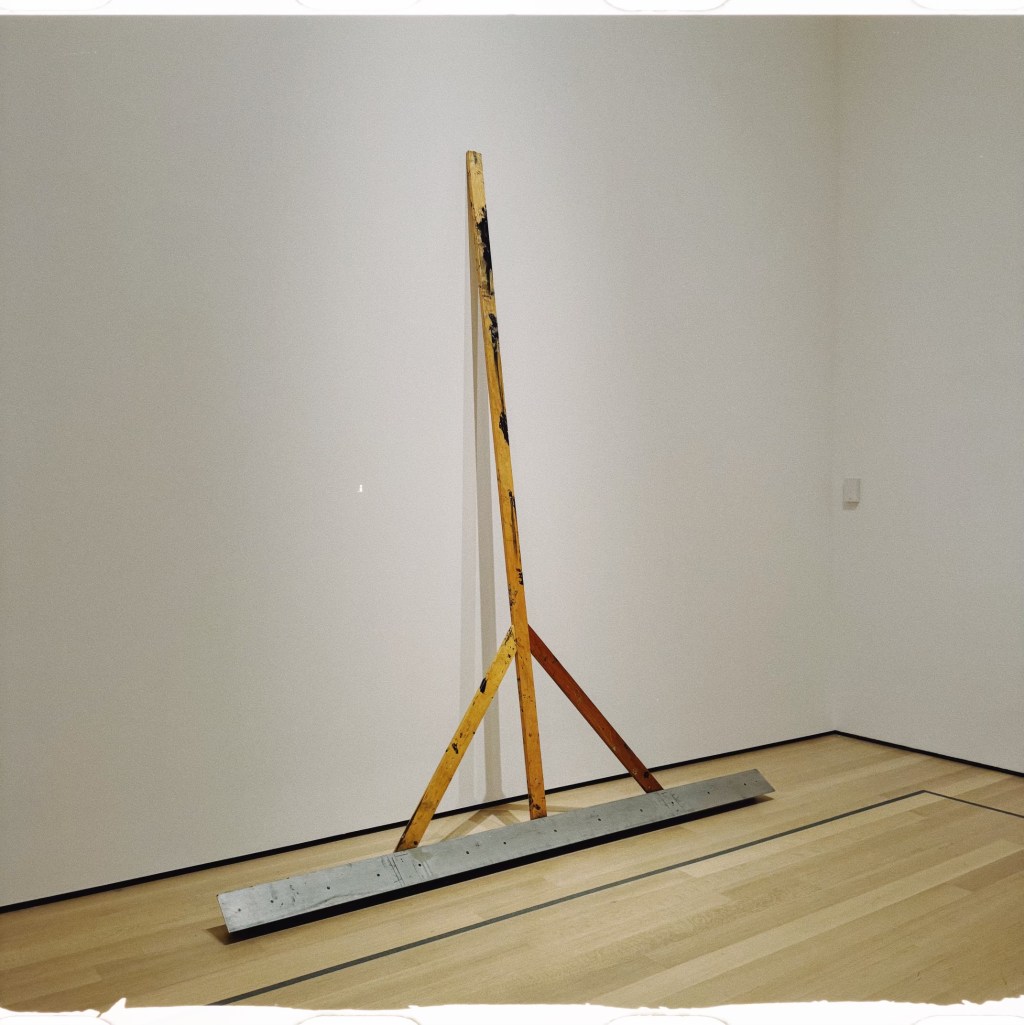
I’ve wanted to write about Jack since seeing him for the first time with a man who gave me the gift of sight spitting in my face. His retrospective, Jack Whitten: The Messenger, at MOMA closed this weekend, where I said my goodbye after saying hello for the eighth time since this winter.
And for one of the first times I read something and only thought about myself. No “I read this and it made me think of you,” or “thinking about you reading. . .”
No contact with the potential of any other world––there is just my own.
This is about not having my cellphone on my person.
I like to go to museums with just a paper and pen.
What follows is what I inscribed on my visit Saturday morning, August 2nd, 2025, not necessarily in order or verbatim, lens tinged towards a pitch about photocopy:
The collection spans different mediums but they depict the same motion. Grids ground each in place. How many ways can one approach the same question?
This is a fun game to play with a person: If you could buy any piece to hang in your home, which would it be? An answer that changes as soon as it’s given, like it should. The first time I was here I said I’d own Omalos (1974) and I didn’t know why. Seeing it now, I see its multiple mediums in one: a black and white photocopy made with paint.
Jack had been offered a residency with Xerox in Rochester, New York. It was 1974. The exhibition follows in suit of time like so. A room is dedicated to each period, though some pieces are intermittently placed that cross through the lines of any linearity—just like the work.
These series experimenting with the new and difficult-to-access technology mechanized the already autonomous action in painting, if one could call it that, for Jack was a photographer merely using paint. “The Developer”––a mark made by whose hand?
In the residency, Jack handed what was already a mystery to another: the Xerox photocopier, a strange cousin of the camera.
Special Checking (1974) was my second choice in the same room. It reminded me of foreign days spent sailing: there’s a mast on the horizon going towards an island in yellow. Moonlight sprinkles over the water and I’m floating into a sunrise. It’s a painful reverie.
Jack had seemed to have known he would be dying with Quartet Wall VIII hanging on his wall (for Arshile Gorky, My First Love in Painting) a tribute to Garden in Sochi (1941). And this is the style Jack is in–self evident and still explained. How lucky we are to have had so much of the artist’s voice.
Coming down after a final homage to Jack, as far as MOMA’s retrospective is concerned, I stopped down to Arshile—so smartly placed—carried forward by the momentum down the escalators. And I paid a tribute, too, standing in front of the Garden. Now sitting under the sun in another, letting the noise drown out in the fountain in front of me:
ShhhhhhHHHHhhHHHHhHHhHHhHShshHHHshhhhhHHhhhhHh—
Where was I? And where was I going?
I found Jack Whitten in the background of Arshile Gorky and thought of Jorge Luis Borges’s Kafka—all these precursors! Yesterday I read a conversation with Philip Guston and it’s like I was there. No. I was there. I had the conversation and I don’t know who quoted who. A question of a chicken or the egg caliber:
These writings are making me miss my diary. I keep moving seats just for the sun to be hidden by a building. Clouds of a different material, I’ve been enjoying the drawings.
Because I swear to God I saw the paint differently today. Yelled at for getting too close to the work, I just want my eyelashes to blink into a butterfly and give it a kiss.
 ByMadelynGrace
Leave a comment